
At Dental Boutique, we refer to our steam sterilisers as autoclaves. These are used to sterilise instruments before use. There are established protocols around testing and maintenance of these units, including daily and yearly testing. These tests are mandatory, and the autoclaves must not be used if these tests have not been performed, or if they have been performed but returned an unsatisfactory result (fail).
As part of our legal obligation to maintain accurate records of all autoclave cycles, the tests that we perform are logged in Core Practice or Principle in the same manner as instrument cycles. It is also essential that we have consecutive autoclave cycles logged in our records, meaning that by failing to log test cycles, we will not have consecutive cycles on record.
VACUUM TESTS:
A vacuum test is a mandatory test to be performed for each autoclave, every day before use. It assesses whether the autoclave components are functioning as directed, and a seal is able to be formed within the unit. If no seal is formed, there will be insufficient vacuum, meaning that air cannot be extracted from hollow or porous items. If air cannot be extracted from these items, then steam cannot penetrate. If steam cannot penetrate and contact ALL surfaces of EACH item inside the chamber, those items will NOT be successfully sterilised, and the load will have failed.
We must check the vacuum function of the steriliser each day. It is normal to have a minute amount of leakage, and for this reason we check the leak rate on the screen at the end of the vacuum test cycle. Any result where the leak rate is 0.8 or less is acceptable. Any result higher than 0.8 means that the vacuum test has failed. In these cases, we refer to the autoclave manufacturer’s instructions for use, repeat the vacuum test, and if still unacceptable, we will need to investigate the issue further and obtain the assistance of an authorised autoclave technician.
The vacuum test cannot be performed on the autoclave if it is hot – we will need to let the unit cool down before performing a vacuum test. The only situation where this is necessary is if the unit has run consecutive vacuum and helix/B&D tests.
HELIX AND BOWIE & DICK-TYPE TESTS:
Helix tests and Bowie & Dick-type (B&D-type) tests are different tests in themselves. At Dental Boutique, we use a combined test device that performs both tests at the same time.
The helix test assesses air removal from HOLLOW devices such as handpieces and triplex tips. The Bowie & Dick-type test assesses air removal from porous items such as gauze and sponges.
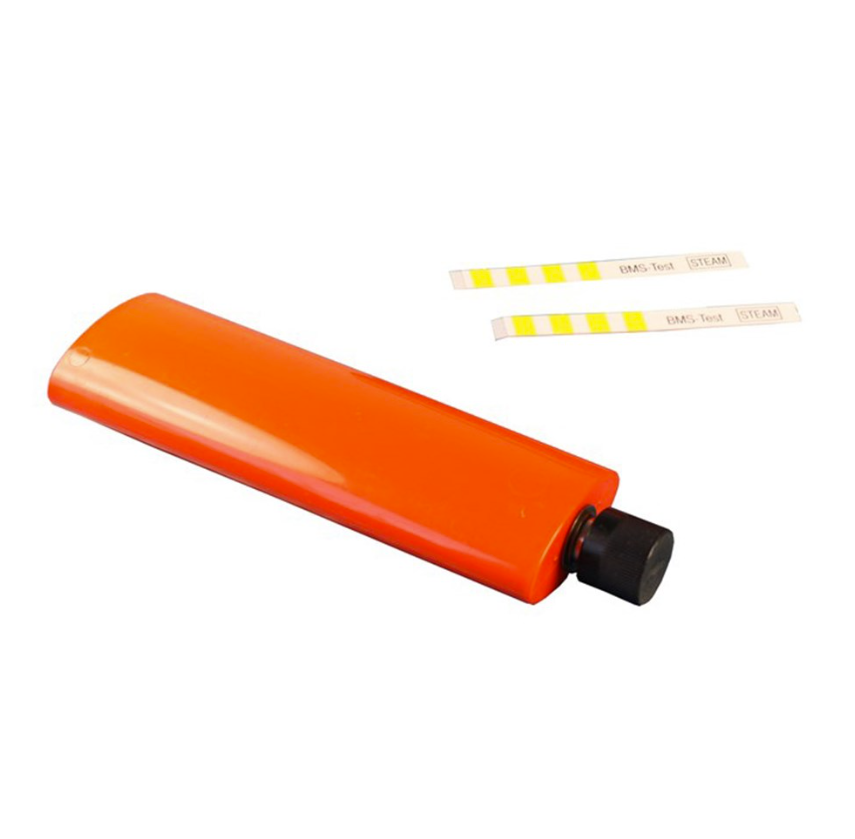
According to the Australian Standards AS5369:2023, it is mandatory to perform the B&D-type test daily, and the helix test where a practice’s risk assessment indicates it is required. Due to the number of hollow instruments that dental practices sterilise on a daily basis, the helix test is therefore mandatory as well. To save time and prevent confusion, Dental Boutique uses the GKE Orange combined helix/B&D-type test device to ensure that both tests are performed daily with the one device:
COMBINED HELIX/BOWIE & DICK TEST INTERPRETATION:

The above shows potential results of the chemical indicator that is placed inside the GKE Orange Helix/B&D-type combined test device. The only acceptable result is that of the first line, where all squares have turned from yellow to black, and is for a cycle with the following parameters: 134°C for minimum 3 minutes or 121°C for minimum 15 minutes (standard cycle). We cannot sterilise instruments unless each autoclave has had a successful Helix/B&D-type test result. Each autoclave must be tested at the start of each day.
Interpretation is as follows:
Line 1: Successful result. All squares on the indicator strip have turned from yellow to brown.
Line 2: Mixed shades. Insufficient air removal and steam penetration.
Line 3: Correct temperature achieved, however no air removal and hence no steam penetration.
Line 4: Insufficient temperature with no air removal and no steam penetration.
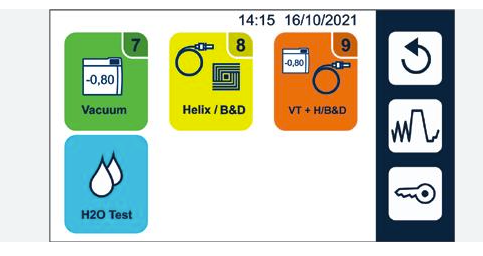
Below is the test cycle menu that appears on the screen of Mocom Futura autoclaves. It shows individual mandatory daily test cycles for Vacuum and Helix/Bowie & Dick tests, and also a combined Vacuum and Helix/B&D (Vacuum, Helix and Bowie & Dick) cycle where the tests are programmed to run one after the other automatically. This saves time in the morning if the tests are pre-programmed the night before, meaning the test cycles can be performed prior to the practice opening for the day.
AUTOCLAVE MAINTENANCE
Always follow the manufacturer’s instructions for use – the manual can be found here. Generally, the outside of autoclaves should be cleaned with neutral detergent. The chamber and door seal (gasket) should be wiped out with a lint free cloth and deionised/demineralised water. Do not use alcohol or abrasive cleaners on the autoclaves as this can damage surfaces and leave residue behind.
MANDATORY SERVICING, CALIBRATION AND VALIDATION
According to Australian Standard 5369:2023 and associated documents, all steam sterilisers including those used in dental practices require calibration, validation and servicing by a licensed technician every 12 months. They must not be used if this periodic work is not undertaken within the required timeframe. If servicing, calibration or validation lapses for a particular autoclave, that unit will require signage to advise that it is not to be used until appropriate remedial work has been completed.
This work requires a considerable amount of time, with the space in steri compromised for the number of hours that the technician requires the space for. For this reason, it is advisable to prebook this service well in advance so space and reduced sterilising capacity can be taken into account in the day’s running of steri and surgeries.
Upon completion of the work, the technician must provide certification and performance documentation as evidence that service, calibration and validation have been carried out. It may take a number of days/weeks for the certificates to be sent to the practice due to potential administrative delays and the need for the technician to send off spore samples to a lab for analysis. In the meantime the technician will have attached a service sticker to the units, however this in itself should not be relied upon as evidence in place of certificates as the pen used can be removed with regular cleaning of the outside of the sterilisers.
SERVICE
It should also be noted that service, calibration and validation are different procedures. Each is required every 12 months. Service involves checking and replacing any components of the steriliser that may need it as a result of daily wear and tear.
CALIBRATION
Calibration is the process of verifying and adjusting the accuracy of an autoclave’s measuring instruments, primarily temperature and pressure sensors, against a known standard. It brings the response of a sensor into a specific range of temperature required for sterilization. This is done by comparing the autoclave sensor’s response to a previously calibrated device, which is called as the “standard”. There is a national reference standard that service engineers abide by.
This ensures the autoclave consistently reaches and maintains the correct temperature and pressure for sterilization. Regular calibration is essential to guarantee the effectiveness of the sterilization process, and the safety of items processed in the autoclave.
VALIDATION
Autoclave validation is a quality assurance procedure to ensure that the autoclave reaches adequate temperature for an adequate amount of time in order to be able to sterilize biological agents and/or instruments. This process is used to assess the efficiency and performance of an autoclave.
Biological indicators (spore tests) are also used to demonstrate that the sterilization process is efficient.
NOTE THAT AUTOCLAVE CALIBRATION AND VALIDATION ARE A MANDATORY REQUIREMENT EVERY 12 MONTHS, AS PER THE AUSTRALIAN STANDARD 5369:2023.
INSTALLATION QUALIFICATION (IQ)
Installation qualification provides documentary evidence that the autoclave has been installed to specification, and that all supporting services such as electricity and water are available and connected properly. The IQ process methodically documents all aspects of the installation, the machine components, and any testing equipment used to provide a complete, closed-loop assessment.
The practice cannot install an autoclave themselves. This must be done by a qualified technician, who will then provide supporting documentation to state that the autoclave has been installed appropriately.
OPERATIONAL QUALIFICATION (OQ)
The operational qualification process verifies that the autoclave meets the desired and intended performance standards of the lab. OQ testing examines the autoclave’s ability to run the sterilization process correctly and repeatedly while also responding appropriately to error conditions. OQ testing typically includes the following tests:
- Simulated load chamber temperature mapping and, if required, verification of sterilization efficacy using biological indicators (BI)
- Empty chamber temperature mapping
- Alarm conditions and expected results
- Operational Qualification (OQ)- process of obtaining and documenting evidence that installed equipment operates within predetermined limits when used in accordance with its operational procedures [ISO/TS 11139:2006]
PERFORMANCE QUALIFICATION
Performance Qualification (PQ) – A process which obtains and documents evidence that the autoclave, as installed and operated in accordance with operational procedures, consistently performs in accordance with predetermined criteria and thereby meets its specification. [ISO TS 11139:2006, definition 2.30]. This is essentially the same as validation.
ISSUES TO BE AWARE OF
It should be noted that some companies will service your autoclave, and the cost may be cheaper than other providers. If this is the case, it is necessary to ensure that they are not only servicing the autoclave but performing calibration and validation services as well.
Please also be aware that if your autoclave is validated and calibrated for a 134 degrees C Standard universal cycle, you should not be using it for other cycles such as 121 degrees C Gentle universal cycle etc. If you use multiple types of cycles, ensure that each type of cycle is also calibrated and validated. This adds considerable cost, which should be taken into account when determining which cycles the practice is most likely to use.
It should also be noted that unless specified by an instrument’s manufacturer, all items should be sterilised in a 134 degrees C Standard Universal cycle. This ensures consistency amongst operators and reduces the risk of user error.